How Laser Tattoo Removal Works: The Full Process, Step by Step
The laser is only half the story. Your immune system does the rest. Here's the complete walkthrough, from your first consultation to the day there's nothing left to treat.
Key Takeaways
- The laser shatters ink into fragments; your immune system carries them away over the following weeks. That's why fading is gradual, not instant.
- The process runs: free video assessment → written plan → treatment sessions → healing between visits → completion (or fade-for-cover-up).
- Laser time is short, typically 5–15 minutes per session, with sessions typically spaced 6–8 weeks apart.
- Most tattoos need somewhere between 5 and 17 sessions; every tattoo responds differently, so estimates are ranges, never promises.
- Most of the visible fading happens between sessions, roughly weeks 4–8, as your body clears the shattered ink.
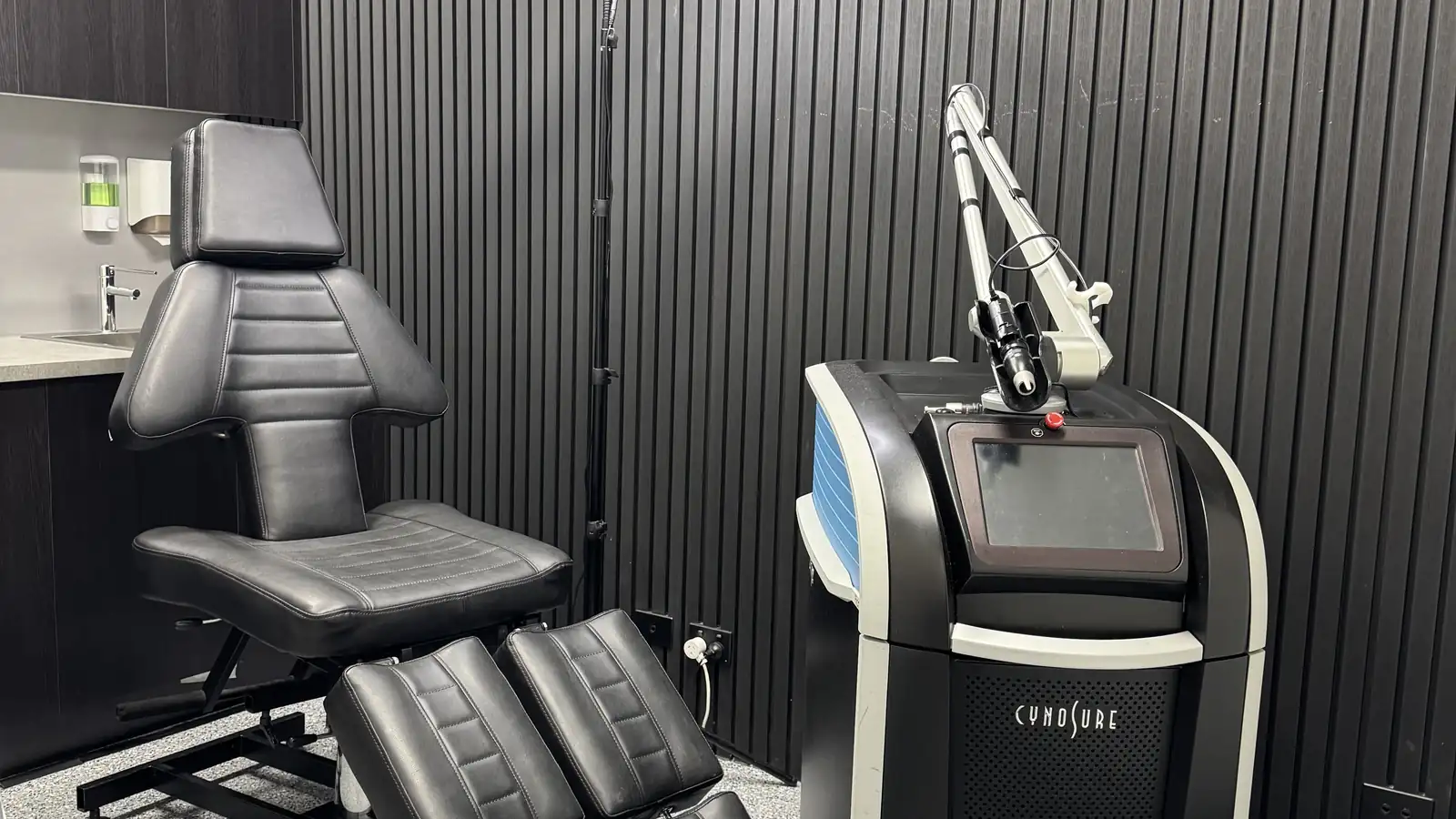
- Ink Off treats with a Cynosure PicoSure picosecond laser on premises in Kensington, from $80 a session.
The Science in Plain English
Tattoo ink is permanent because the pigment particles your artist deposited in your dermis are too large for your immune system to haul away. Your body tried when the tattoo was fresh. It just couldn't shift them. So they sit there, locked in place, for decades.
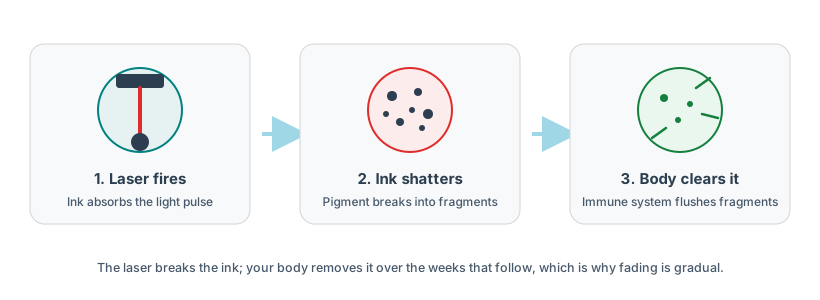
A removal laser changes the maths. It fires pulses of light, at wavelengths chosen to match your ink, that pass through the surface of the skin and get absorbed by the pigment underneath. Each pulse fractures the particles it hits into much smaller pieces. Once the fragments are small enough, your immune system can finally do what it's been trying to do since day one: collect them and flush them out through your lymphatic system.
Ink Off's laser is a Cynosure PicoSure, a picosecond system that's ARTG-included and FDA-cleared, on premises at the Kensington clinic. Its pulses last trillionths of a second, short enough that the dominant effect on ink is photomechanical: a pressure wave that cracks pigment apart, rather than the mainly heat-driven (photothermal) action of older Q-switched machines. The finer fragments it produces are easier for your body to clear, which is why picosecond lasers often need fewer sessions than older Q-switch lasers. There's a deeper dive on our PicoSure technology page.
The key mental model: the laser breaks; your body removes. Everything else about the process (the multiple sessions, the gaps between them, the gradual fading) follows from that.
Step 1: Consultation and Assessment
Everything starts with an honest look at your tattoo. At Ink Off that's a free 20-minute video assessment, no obligation, where your practitioner examines the ink colours, density, placement and your skin type, talks through your goal (full removal, or fading for a cover-up), checks there's no reason to hold off treating, and gives you a written plan before you pay anything.
If you'd rather get a read before setting foot in the clinic, the free 2-minute candidacy check takes about two minutes. It's built on the Kirby-Desai scale, a validated clinical scoring system published in dermatology literature, which weighs six factors: skin type, tattoo location, colour, ink density, scarring, and layering. The output is a provisional session range, not a promise, because every tattoo responds differently.
Why do those factors matter so much?
- Ink colour: black clears fastest; greens, yellows and whites are the stubborn end.
- Placement: areas with strong circulation (closer to the heart) tend to clear faster than hands, feet and lower legs.
- Tattoo age: older ink has usually already partially broken down, so it often fades faster.
- Ink density and layering: dense professional work and cover-ups sitting over older tattoos take longer.
- Your health: the removal is done by your immune system, so smoking, sun exposure and general health genuinely move the needle.
As a rule of thumb, most tattoos need somewhere between 5 and 17 sessions, and rarely fewer than about 4. If your goal is fading for a cover-up rather than complete removal, the job is smaller, often around 3–5 sessions.
Step 2: Getting Ready for Your First Session
Preparation is unglamorous but it directly affects your results. The essentials: keep the tattoo out of the sun (and off the fake tan) for several weeks before treatment, arrive with the area clean and free of creams or perfume, stay hydrated, and skip anything that impairs healing. Sun-darkened skin competes with the ink for laser energy, which forces more conservative settings and slows your progress.
The complete checklist (what to do in the fortnight before, the day before, and the morning of your appointment) is on our preparation guide.
Step 3: What Happens in a Treatment Session
The appointment itself is shorter than most people expect. Your practitioner photographs the tattoo (so progress can be tracked objectively), cleans the area, gives you protective eyewear, and confirms the laser settings for your skin and ink. Then the actual laser work begins, typically 5–15 minutes, depending on the size of the piece.
Two things you'll notice during and immediately after treatment:
- The sensation. Most people compare each pulse to a hot rubber band snapping against the skin. It's sharp but fast, and because sessions are short, it's over quickly.
- Frosting. The treated ink turns chalky white within seconds. That's tiny gas bubbles forming in the skin as pigment shatters, a normal, expected sign the laser hit its target. It settles down within roughly half an hour.
Before you leave, the area is dressed and you get aftercare instructions. Door to door, most visits fit inside half an hour, easy enough to slot into a weekday evening, since the clinic runs Wednesday and Thursday 10am–9pm, Friday 10am–8pm and Saturday 10am–5pm.
Step 4: What Happens Between Sessions
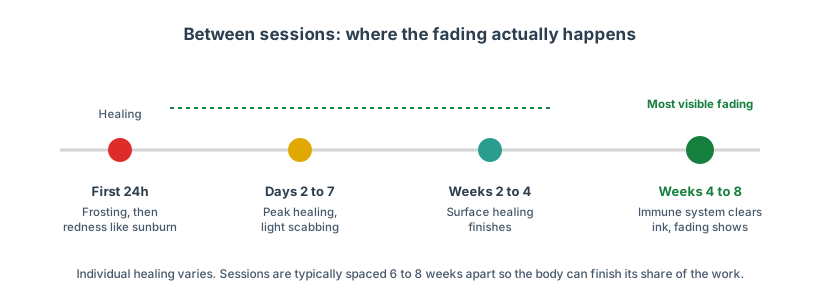
This is the part most guides skim, and it's where the actual removal happens. Here's the typical arc after each session. Individual healing varies, so treat this as a guide, not a schedule.
| Timeframe | What's typically happening |
|---|---|
| First 24 hours | Frosting fades within about half an hour; redness, swelling and warmth follow, similar to sunburn. Small blisters can appear: normal, don't pop them. Keep the dressing on and the area clean. |
| Days 2–7 | Peak healing. Blisters settle, light scabbing can form around days 3–5, and the area may itch. Don't scratch or pick. Skip pools, spas and saunas this week. |
| Weeks 2–4 | Surface healing wraps up. Scabs lift on their own, skin underneath may look pink or slightly light/dark, usually temporary. Normal exercise is generally fine again after the first fortnight. Sunscreen on the area whenever it's exposed. |
| Weeks 4–8 | The quiet workhorse phase: your immune system clears the shattered ink beneath fully healed skin. This is often when fading is most visible, and it's exactly why the next session waits until now. |
How well you look after the area in that first fortnight directly affects both your skin and your results. The full routine is on our aftercare guide. One habit worth building: photograph the tattoo in the same light before every session. Fading is gradual enough that memory undersells it; photos don't.
Why It Takes Multiple Sessions, and Why the Gaps Matter
A single session can't clear a tattoo, no matter how good the laser, for two structural reasons. First, ink sits in layers, and each pass mainly breaks up the shallowest ink it can reach. Deeper pigment becomes reachable only after the layer above it has been cleared. Second, your immune system has a finite clean-up rate. Firing more laser at fragments your body hasn't collected yet adds skin trauma without adding removal.
That's why sessions are typically spaced 6–8 weeks apart. The gap isn't the clinic stretching things out. It's the biology doing its share of the work. Expect early sessions to produce the most dramatic change, with later sessions refining what's left; the thinner the remaining ink, the subtler each step looks.
Cost note: multi-session treatment is exactly why the per-session price matters more than any single number. Ink Off prices from $80 (extra small) to $300 (extra large, up to A4), no contract, no credit check, no lock-in, so you only ever pay for the sessions you actually need. Melbourne clinics' median advertised price sits around $70 a session, with big-chain pricing running from $100 to $743 (TRG directory data, August 2026). Compare for yourself with the pricing calculator.
Completion: How You Know You're Done
"Done" depends on the goal you set back at step one. For full removal, it's the point where no visible ink remains and your practitioner confirms there's nothing left worth treating, keeping in mind the skin can continue settling for a few months after the final session. For a cover-up, it's earlier: the moment the old piece is light enough for your new design, which is worth coordinating with your tattoo artist. (Ink Off shares its premises with Mother Goose Tattoo Studio, which handles cover-up work, so both halves of that plan can happen in one place.)
Progress reviews happen along the way. The session-by-session photos make it obvious whether your tattoo is tracking inside its estimated range. And the whole treatment is backed by Ink Off's 100% money-back guarantee. Conditions apply, and worth reading before you start.
If you want to see what the end of the road looks like on real skin, the results gallery shows genuine Ink Off clients across the fading journey.
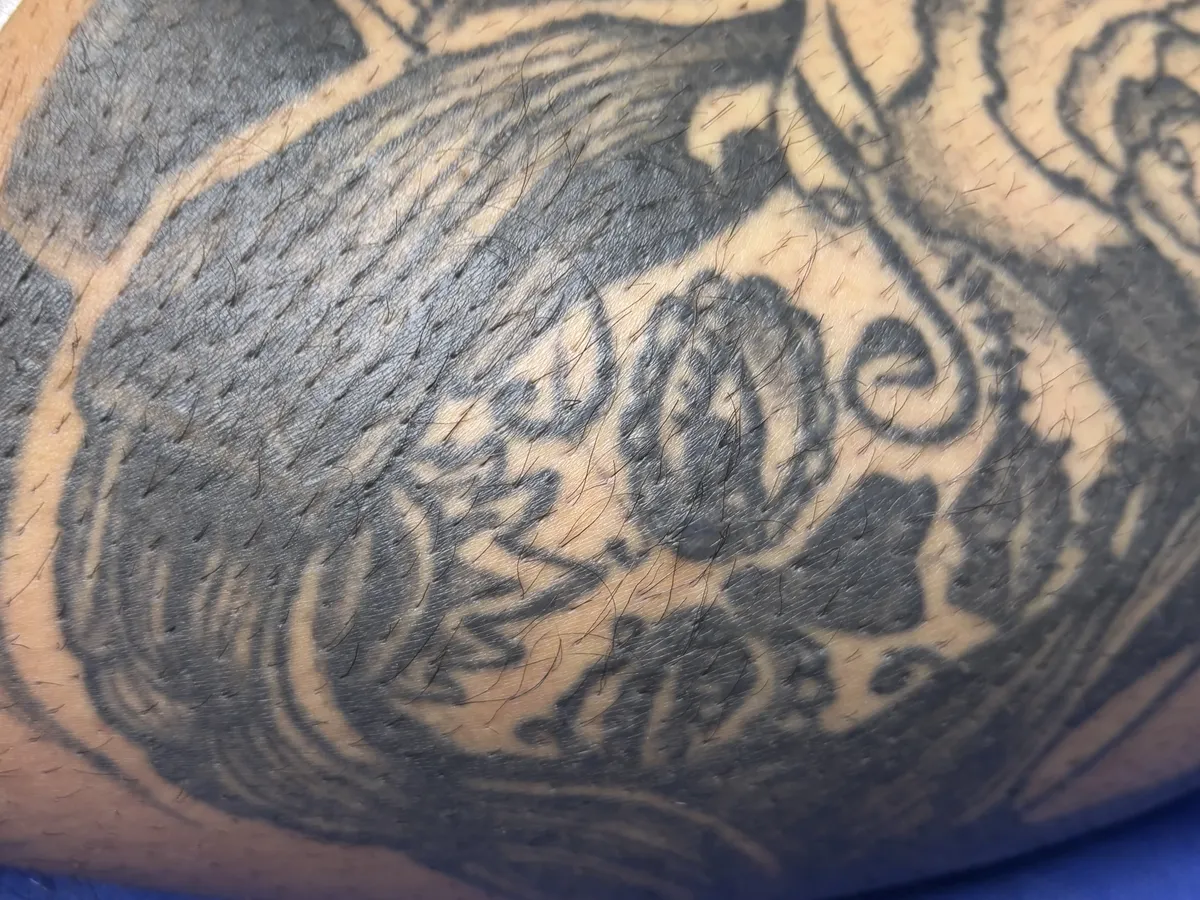
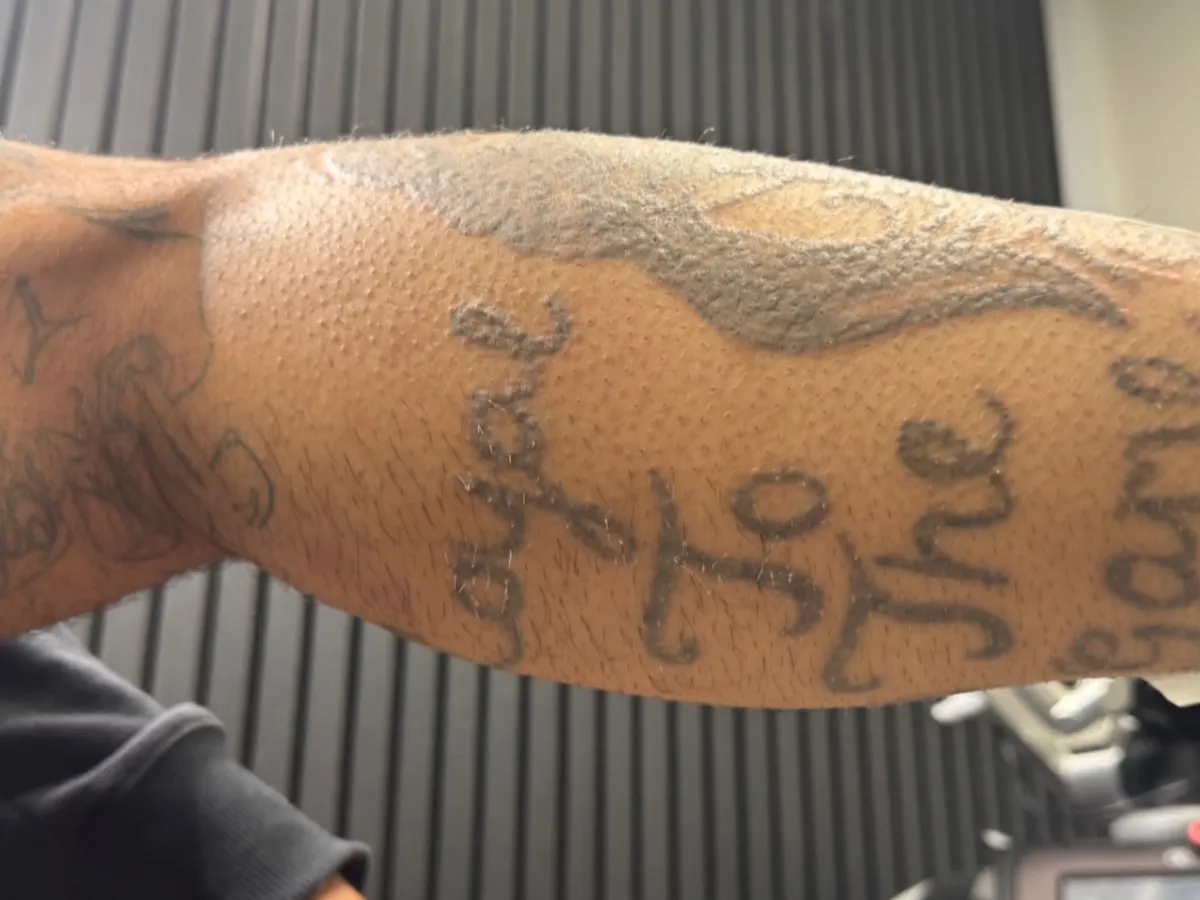
Real client results. Identifying details removed to protect privacy. Individual results vary; some inks fade rather than fully clear. The fading shown is the real recorded result, never fabricated or enhanced.
Frequently Asked Questions
The laser fires ultra-short pulses of light at wavelengths your ink absorbs. Each pulse shatters pigment particles into fragments small enough for your immune system to collect and carry away over the following weeks. The laser does the breaking; your body does the removing, which is why fading shows up gradually after each session, not on the treatment table.
The laser work itself typically runs 5 to 15 minutes, depending on the size of the tattoo. With check-in, photos and aftercare instructions, most people are in and out of the Kensington clinic within half an hour.
Sessions are typically spaced 6 to 8 weeks apart. That gap isn't padding. It gives your skin time to heal fully and your immune system time to flush out the ink fragments the last session created. Treating again too soon adds risk without adding results.
Most tattoos need somewhere between 5 and 17 sessions, and rarely fewer than about 4. Every tattoo responds differently. Factors like ink colour, density, age, placement and your skin type all shift the number. The Kirby-Desai scale, a validated clinical scoring system, is used to turn those factors into a provisional range at your assessment, a range, never a promise.
No, and that's normal. Right after treatment the area frosts white for around half an hour, then looks red and swollen for a few days. The real fading happens over the following 4 to 8 weeks as your immune system clears the shattered ink. Many people notice the biggest visible change late in that window, just before their next session.
Sources & About This Guide
- Kirby W, Desai A, Desai T, Kartono F, Patel G. The Kirby-Desai Scale: A Proposed Scale to Assess Tattoo-Removal Treatments. J Clin Aesthet Dermatol. 2009;2(3):32–37.
- Cynosure PicoSure product and regulatory documentation (ARTG inclusion; FDA clearance).
- Further reading: Understanding the tattoo removal process, a neutral explainer on Tattoo Removal Guide (directory operated by Ink Off's founder).
This guide is general information, not medical advice. Ask your practitioner (or your GP) about your specific situation. Healing timelines are typical patterns, not guarantees. Follow the aftercare instructions given at your own appointment. Pricing describes Ink Off's offer as at July 2026.
Related Guides
Ready to Find Out What Your Tattoo Needs?
Get a provisional session range in two minutes with the free Check My Tattoo tool, or book a free 20-minute video assessment with the team, no obligation either way.
100% Money-Back Guarantee (conditions) • PicoSure Laser • From $80 a Session