PicoSure vs Q-Switched Lasers: What Actually Matters
Laser manufacturers spend a lot of money convincing you their machine is the whole story. It isn't. Here's a plain-English breakdown of how the two laser families differ, which one suits which ink, and why we chose PicoSure for our Kensington studio.
Key Takeaways
- Both laser families remove tattoos. Q-switched lasers work mainly through heat (photothermal); picosecond lasers like PicoSure work mainly through a pressure wave (photomechanical).
- Picosecond treatment often needs fewer sessions than older Q-switch lasers, but no laser comes with a fixed number. Most tattoos land somewhere between 5 and 17 sessions, and every tattoo responds differently.
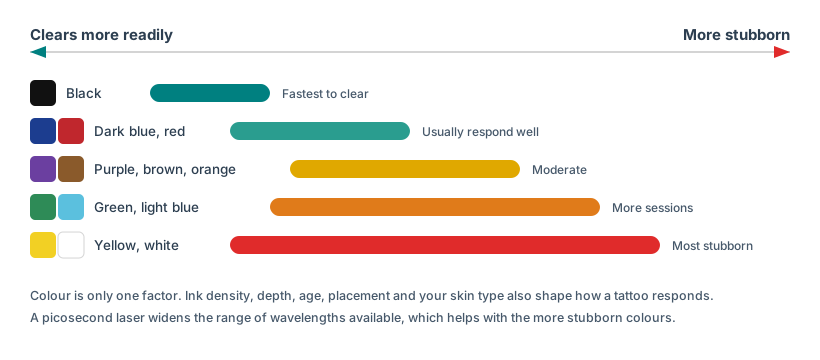
- Q-switched lasers still handle black ink well. Where picosecond wavelengths pull ahead is on stubborn blues, greens and purples.
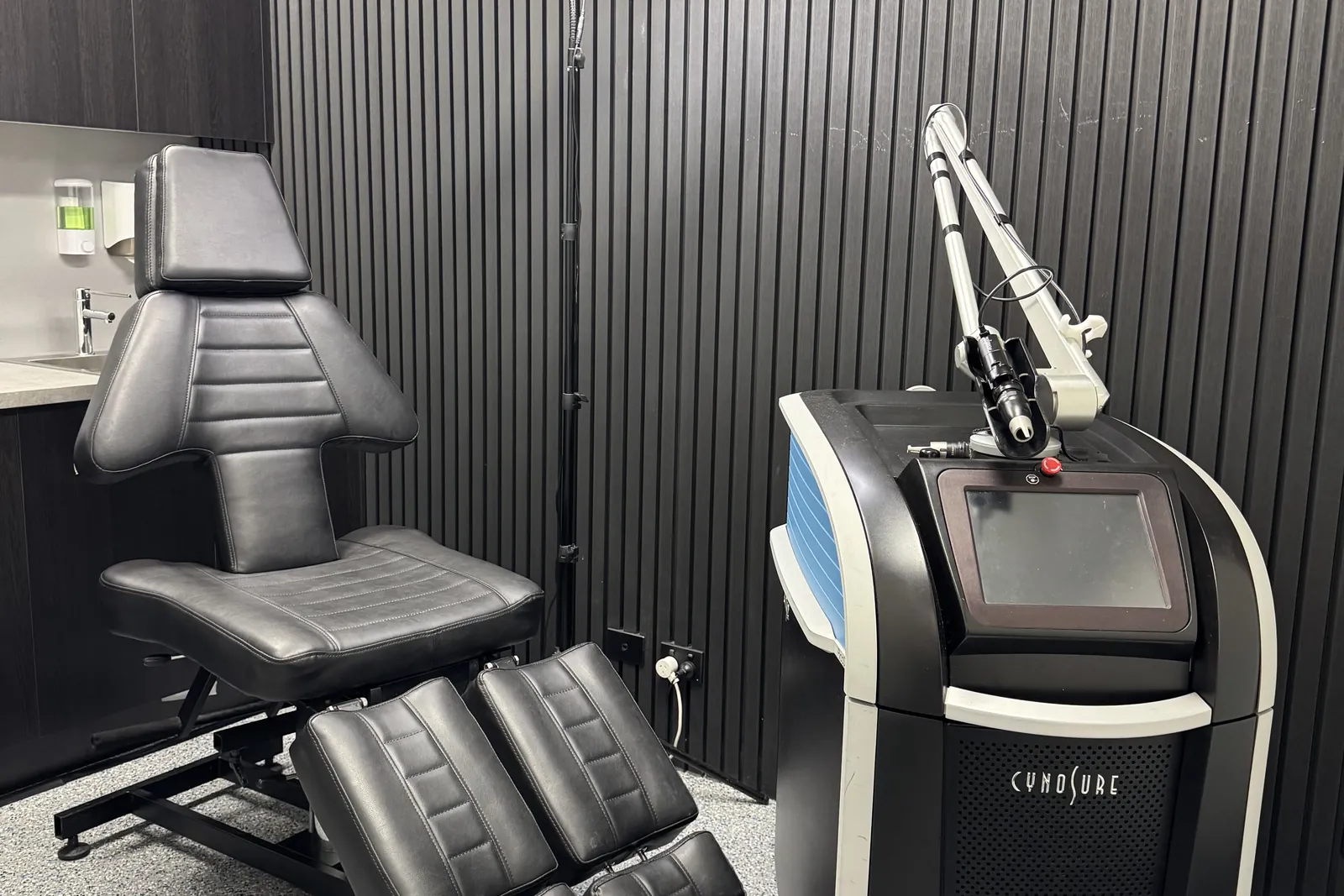
- Ink Off runs a Cynosure PicoSure, ARTG-included and FDA-cleared, on premises in Kensington, minutes from the Melbourne CBD.
- The person holding the handpiece, and your tattoo itself, matter more to your result than the brand of laser on the wall.
The Short Answer
If you've started researching tattoo removal in Melbourne, you've probably run into the picosecond-versus-Q-switched debate. One camp says picosecond technology has made everything else obsolete. The other says Q-switched machines have thirty years of runs on the board and nothing to prove.
Here's the honest position: both remove tattoos. They differ in how they break up ink, which colours they handle most comfortably, and how many sessions the job tends to take. Those differences are real, but your tattoo's colours, age, ink depth and position on your body shape your result at least as much as the machine does.
This guide walks through the mechanics of each laser type, where each one shines, and why we chose a Cynosure PicoSure for Ink Off.
What Both Lasers Have in Common
Every laser tattoo removal treatment, regardless of brand, relies on the same partnership between light energy and your immune system.
The laser fires an extremely short pulse of light at a wavelength chosen to match your ink. The pulse passes through the upper layers of skin, is absorbed by the pigment in the dermis, and breaks the ink into smaller fragments. From there, your body takes over: immune cells collect the fragments and clear them out through your lymphatic system over the following weeks.
That clean-up phase is why sessions are typically spaced 6–8 weeks apart. Lasering again before your body has flushed the last round of fragments doesn't speed anything up. It's also why tattoos on well-circulated areas (chest, upper arms) tend to fade sooner than those on hands, feet and ankles.
Where the two laser families part ways is the length of each pulse, and what that pulse length does to the ink.
Q-Switched Lasers: The Established Workhorse
Q-switched lasers deliver pulses measured in nanoseconds, billionths of a second. They've been the backbone of tattoo removal since the 1990s, and plenty of Melbourne clinics still run them, most commonly Q-switched Nd:YAG machines operating at 1064nm and 532nm.
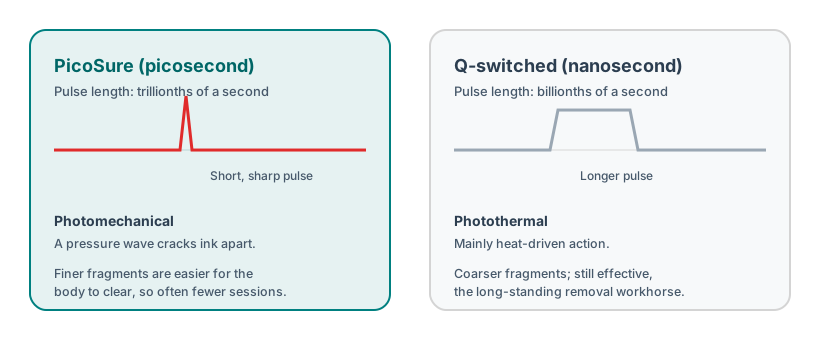
A nanosecond pulse works primarily through a photothermal effect: the light energy rapidly heats the ink particles, and that heating fractures them. It's a proven approach with a long clinical track record, and it's genuinely effective, particularly on the inks it was built around:
- 1064nm handles black and very dark blue ink, the bulk of most Australian tattoos.
- 532nm targets reds and oranges.
One myth worth retiring: the claim that Q-switched lasers can't treat colour. They can, and they do. Many colour tattoos in Melbourne have been fully removed on Q-switched machines. The honest limitation sits at the awkward end of the palette: certain greens, blues and purples can plateau under nanosecond treatment, holding their ground session after session.
Picosecond Lasers: A Different Way to Break Ink
Picosecond lasers, PicoSure, PicoWay and similar platforms, compress each pulse into picoseconds: trillionths of a second. Squeezing the energy into a much shorter pulse changes the dominant mechanism from heat to pressure. Instead of mainly cooking the ink particle, the pulse generates a photomechanical shockwave, a pressure wave that shatters the particle.
Smaller fragments are easier for your immune cells to carry away, which is the practical reason picosecond treatment often needs fewer sessions than older Q-switch lasers. It's also why picosecond wavelengths have built a reputation on the stubborn colours, the greens, blues and purples that resist nanosecond treatment, and on tattoos that stalled partway through a course on an older machine.
Two caveats keep this honest. First, "often fewer sessions" is not a promise: every tattoo responds differently, and no practitioner can hand you an exact number upfront. Second, a picosecond laser in inexperienced hands won't outperform a Q-switched laser run by someone who knows exactly what they're doing.
Side by Side
| Q-Switched | Picosecond (PicoSure) | |
|---|---|---|
| Pulse length | Nanoseconds (billionths of a second) | Picoseconds (trillionths of a second) |
| Main mechanism | Photothermal: heat fractures the ink | Photomechanical: a pressure wave shatters the ink |
| Track record | In clinical use since the 1990s | Newer; PicoSure was the first picosecond platform to market |
| Strongest on | Black, dark blue (1064nm); reds (532nm) | Black plus stubborn blues, greens and purples (755nm on PicoSure) |
| Session count | Ranges only: most tattoos need somewhere between 5 and 17 sessions | Same ranges apply, though picosecond often needs fewer sessions than older Q-switch lasers |
Notice what's not in that table: any multiplier claiming one machine outpaces the other. You'll see numbers like that in laser marketing. Treat them with suspicion. Your skin isn't a brochure.
Why Ink Off Runs PicoSure
Setting up our Kensington studio, we faced the same choice as every clinic: a cheaper, proven Q-switched machine, or a picosecond platform. We chose the Cynosure PicoSure, and it lives on premises. Three reasons:
- The mechanism. The photomechanical pressure-wave approach fragments ink finely, and often means fewer sessions than older Q-switch lasers. Since you pay per session, fewer visits is a real saving in time and money.
- The 755nm wavelength. PicoSure's core wavelength handles black ink and reaches the difficult end of the palette, the blues and greens that make some tattoos plateau on older machines. You can see how different inks respond in our results gallery, and there's a deeper dive on the machine itself on our technology page.
- The paperwork. The PicoSure is ARTG-included and FDA-cleared. If a clinic can't tell you what device they run and where it stands with the regulator, keep walking.
Melbourne context: picosecond technology is still the exception here, not the rule. In the Tattoo Removal Guide directory's May 2026 analysis of Australian clinics, roughly a quarter of Melbourne clinics offered picosecond technology, with Q-switched machines more common, almost the reverse of Sydney, where picosecond adoption leads. Both types produce near-identical patient satisfaction ratings nationally, which says a lot about how much the practitioner matters.
What Matters More Than the Laser
Whichever machine ends up over your tattoo, four things will influence your result more than the brand name:
- Your tattoo itself. Ink colours, density, depth, age and size set the difficulty. A faded fifteen-year-old black script behaves nothing like a dense, fresh colour sleeve. The Kirby-Desai scale, a validated clinical tool published in 2009, scores exactly these factors to produce a session-range estimate. Our free 2-minute candidacy check uses it to give you a provisional range in about two minutes. A range, mind you, never a promise.
- Placement. Closer to strong circulation means faster clearing. Fingers, feet and ankles are the slow lane.
- Your body. Your immune system does the actual removal between sessions. Hydration, general health and not smoking all help it along.
- The practitioner. Wavelength selection, energy settings, spot size, treatment pace. These are judgement calls made at every session. Experience shows.
Sessions themselves are quick with either technology, typically 5–15 minutes, and spaced 6–8 weeks apart while your body does the clean-up.
What About Cost?
Picosecond machines cost clinics considerably more to buy and maintain, and many pass that premium on per session. Worth knowing when you compare quotes: a cheaper per-session price on an older machine can cost more overall if the course runs longer.
We took a different route. Ink Off prices PicoSure treatment per session, from $80 for an extra-small tattoo up to $300 for an extra-large piece (up to A4), no contract, no credit check, no lock-in, pay per session, stop whenever you want. Pieces larger than A4 are treated in sections, quoted at your consult. Melbourne clinics' median advertised price sits around $70 a session, with big-chain pricing running from $100 to $743 (TRG directory data, August 2026). Run your own numbers in our pricing calculator.
And because no laser can promise an outcome, we back the work with a 100% money-back guarantee (conditions apply).
Frequently Asked Questions
Neither type is better for every tattoo. Q-switched lasers have decades of results behind them, especially on black ink. Picosecond lasers like PicoSure work through a pressure-wave (photomechanical) effect rather than heat alone, and often need fewer sessions than older Q-switch lasers. Your tattoo's colours, age, depth and placement matter more than the logo on the machine.
Ink Off runs a Cynosure PicoSure picosecond laser on premises at our Kensington studio, minutes from the Melbourne CBD. The PicoSure is ARTG-included and FDA-cleared, and its 755nm wavelength is well suited to black ink as well as stubborn blues and greens.
There is no exact number for any tattoo. Most tattoos need somewhere between 5 and 17 sessions, with around 4 as a realistic minimum, and every tattoo responds differently. Ink colours, density, age, placement and your own body all shift the range. Picosecond lasers often need fewer sessions than older Q-switch lasers, but the range still applies.
Yes. Q-switched lasers remove many colours well, particularly black and dark blue at 1064nm and reds at 532nm. The idea that only picosecond lasers can treat colour is a marketing myth. Where picosecond wavelengths tend to earn their keep is on stubborn blues, greens and purples that resist other treatment.
Picosecond machines cost clinics more to buy and maintain, so many charge a premium for them. Ink Off prices PicoSure treatment per session, from $80 for an extra-small tattoo up to $300 for an extra-large piece, no contract, no credit check, no lock-in. Compare the totals for your tattoo with our pricing calculator.
Sources & About This Guide
- Kirby W, Desai A, et al. “The Kirby-Desai Scale: A Proposed Scale to Assess Tattoo-Removal Treatments.” J Clin Aesthet Dermatol, 2009.
- Cynosure PicoSure device documentation, ARTG-included and FDA-cleared picosecond laser platform.
- Tattoo Removal Guide directory, analysis of laser technology adoption across Australian clinics (May 2026).
Tattoo Removal Guide is an independent clinic directory operated by Ink Off's founder. This guide is general information, not medical advice. Ask your practitioner (or your GP) about your specific situation.
Related Guides
Find Out How Your Tattoo Would Respond
Two minutes online, or fifteen minutes in the chair with our team in Kensington. Either way, you'll leave with a realistic session range for your tattoo, not a sales pitch.
100% Money-Back Guarantee (conditions) • PicoSure Laser • From $80 a Session