Colour Tattoo Removal in Melbourne: Which Inks Respond Best?
Black ink is the easy part. Colour is where the physics gets picky, and where the laser your clinic runs actually matters. Here's an honest breakdown, colour by colour.
Key Takeaways
- Lasers remove ink by matching a wavelength of light to a pigment that absorbs it. Black absorbs almost everything, so it clears fastest.
- Green is demanding: it responds best to 755nm light, a wavelength many Melbourne clinics simply don't have.
- Yellow, white and pale pastels are the genuinely stubborn colours. Some may never clear completely, and anyone who promises otherwise is guessing.
- Ink Off's Cynosure PicoSure runs at 755nm, which suits black, dark blue and green ink; it's ARTG-included and FDA-cleared.
- Most tattoos need somewhere between 5 and 17 sessions, and colour work usually sits higher in that range. Every tattoo responds differently.
- Fading a colour piece for a cover-up is a smaller job than full removal, often around 3–5 sessions.
Why Ink Colour Decides Everything
A tattoo removal laser doesn't burn ink away. It fires an extremely short pulse of light at one specific wavelength, and any pigment that absorbs that wavelength shatters into fragments small enough for your immune system to carry off. Pigment that reflects the wavelength barely notices the treatment.
That single fact explains almost everything about colour removal. Black ink absorbs light across the spectrum, so nearly any tattoo removal laser can break it down. Coloured pigments are fussier. Each one absorbs some wavelengths and bounces the rest. A laser that makes short work of a black script tattoo can pass straight over a yellow sunflower without doing much at all.
So when you're comparing Melbourne clinics for a colourful piece, the first question isn't price or postcode. It's: which wavelengths can your laser actually produce, and do they match my ink?
Black and Grey: The Easy End of the Spectrum
If your tattoo is entirely black and grey, you're in the simplest category. The 1064nm wavelength found on virtually every Nd:YAG and picosecond system targets black ink reliably, and grey is just diluted black. Most clinics in Melbourne can treat black and grey competently, which frees you up to compare on the things that separate a good clinic from an average one: experience, laser generation, honesty about session counts, and price. You can run that last comparison yourself with our pricing calculator.
Black ink also tends to show the most dramatic early progress. You can see what real fading looks like session by session in our results gallery, which includes both blackwork and colour pieces.
The Colour Hierarchy: From Cooperative to Stubborn
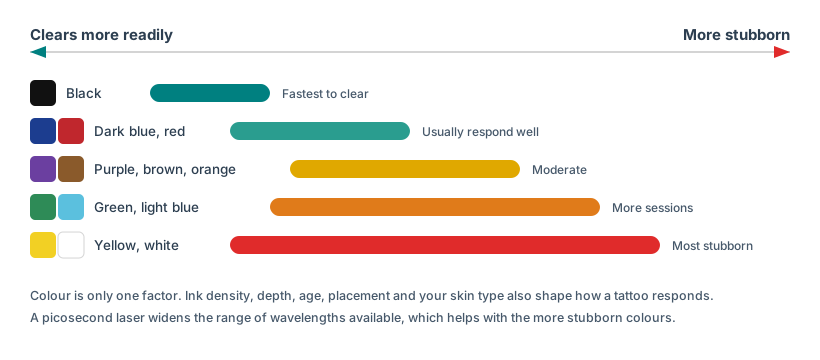
Here's how the common tattoo colours stack up, from easiest to hardest. Wavelengths are listed because they're the detail worth asking any clinic about.
| Ink colour | How it responds | Best-suited wavelengths |
|---|---|---|
| Black & grey | The most cooperative: absorbs nearly all laser light | 1064nm, also responds to 755nm |
| Dark blue | Generally clears well | 1064nm, 755nm |
| Red, orange | Usually respond well, on the right wavelength | 532nm |
| Green | Stubborn on standard 1064nm systems; needs specific wavelengths | 755nm (Alexandrite), 694nm (Ruby) |
| Light blue, purple | Mixed: depends on the exact pigment blend | 755nm, 694nm, 532nm |
| Yellow, white, pastels | The hardest: reflect most laser light; may never fully clear | No wavelength works reliably |
One extra wrinkle: tattoo inks aren't standardised. Two "green" tattoos from different artists can contain completely different pigment chemistry and respond completely differently. That's a big part of why every tattoo responds differently, and why any session estimate is a provisional range rather than a promise.
The Honest Bit: Greens, Yellows and White
Plenty of clinics gloss over this, so let's not. Some colours are genuinely hard to remove, and a few may never disappear completely.
Green
Green is beatable, but only with the right tool. It absorbs poorly at 1064nm, the workhorse wavelength most clinics rely on, and responds far better at 755nm or 694nm. If a clinic can't tell you their laser produces one of those wavelengths, expect slow progress on green ink no matter how many sessions you buy.
Yellow and pale pastels
Yellow reflects most of the light a removal laser can produce, which means there's often very little energy transferred into the pigment. Significant fading is possible in some cases, but complete clearance of yellow is unreliable with any current laser system. If someone quotes you a fixed number of sessions to fully erase a yellow-heavy piece, be sceptical.
White ink
White is the wildcard. Some white and flesh-tone pigments contain compounds that can oxidise under laser light, meaning the ink can turn darker before it gets lighter. A careful practitioner will test a small, discreet patch first and review how it settles before treating the full area.
Worth asking any clinic: "Which wavelengths does your laser produce, and can I see healed results on ink the same colour as mine?" A good clinic answers both without flinching.
Where PicoSure's 755nm Wavelength Fits In
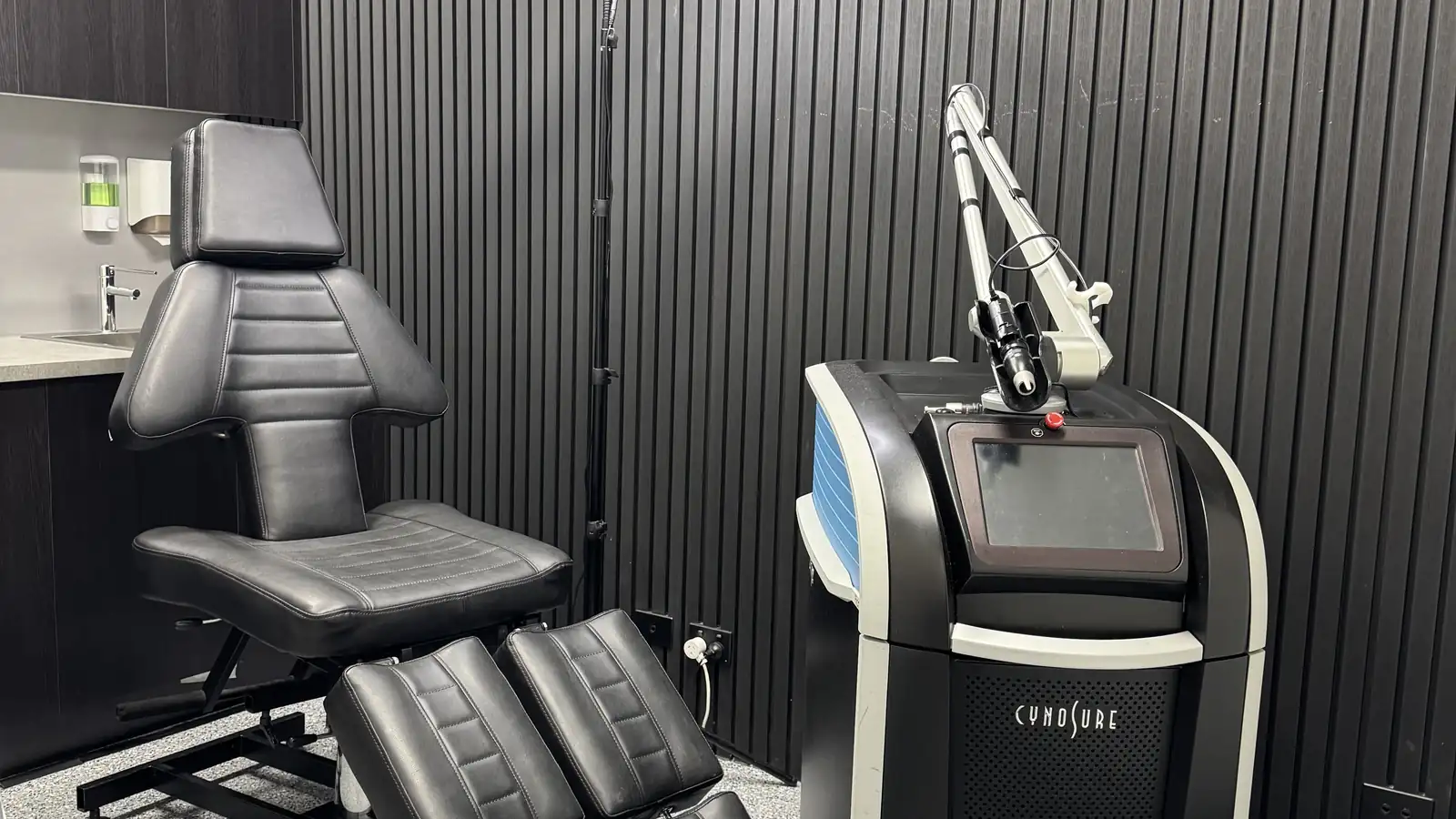
Ink Off's clinic in Kensington runs a Cynosure PicoSure, a picosecond laser that's ARTG-included and FDA-cleared, on premises. Two things about it matter for colour work.
First, the wavelength. PicoSure's core wavelength is 755nm, produced by an Alexandrite lasing medium. As the table above shows, 755nm sits in the sweet spot for black, dark blue and (crucially) green ink, the colour that frustrates standard 1064nm setups. If your piece mixes blackwork with green shading, that combination plays to this laser's strengths.
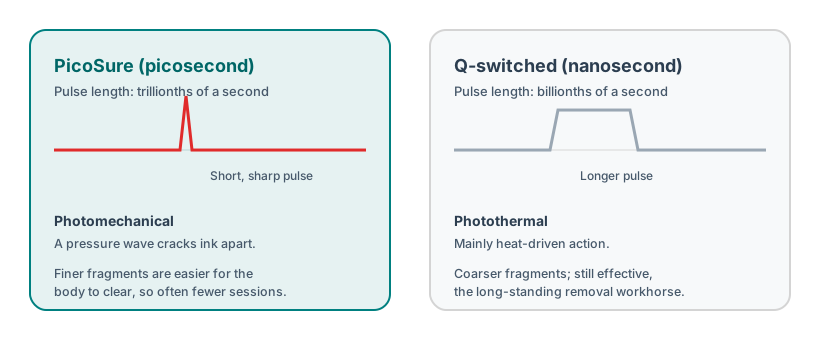
Second, the pulse. Picosecond lasers deliver energy in pulses measured in trillionths of a second. At that speed the effect on ink is photomechanical, a pressure wave that cracks pigment particles apart, rather than mainly photothermal (heat-driven), which is how older Q-switched lasers work. Finer fragments are easier for your immune system to clear, which is why picosecond systems often need fewer sessions than older Q-switch lasers. You can read more about the machine itself on our PicoSure technology page.
And the honest counterweight: no single laser is best at every colour. Red and orange pigments respond best to 532nm light, and yellows remain difficult for every system on the market. If your tattoo is dominated by colours we don't expect to respond well, you'll hear that plainly at your consultation, not after 10 sessions.
Fading for a Cover-Up: A Different Goal, a Smaller Job
Not everyone with an unwanted colour tattoo needs it gone entirely. If your plan is a cover-up, you only need the old ink light enough for a new design to sit cleanly over the top, and stubborn colours matter far less, because residual traces can hide under fresh work.
Fading for a cover-up typically takes around 3–5 sessions rather than a full removal course. It's worth saying up front at your consultation, because it changes the whole treatment plan. Ink Off shares its Kensington premises with Mother Goose Tattoo Studio, which does cover-up work, so fading and the eventual new tattoo can be planned under the same roof.
What Colour Means for Sessions and Cost in Melbourne
Because coloured pigments each respond at their own pace, colour pieces usually land higher in the session range than plain black tattoos. As a rule of thumb, most tattoos need somewhere between 5 and 17 sessions (rarely fewer than about 4), with sessions typically spaced 6–8 weeks apart, and colour is one of the factors that pushes a tattoo toward the upper end. The free 2-minute candidacy check uses the Kirby-Desai scale, a validated clinical scoring system, to weigh your ink colours alongside size, location and skin type, and gives you a provisional range in about two minutes.
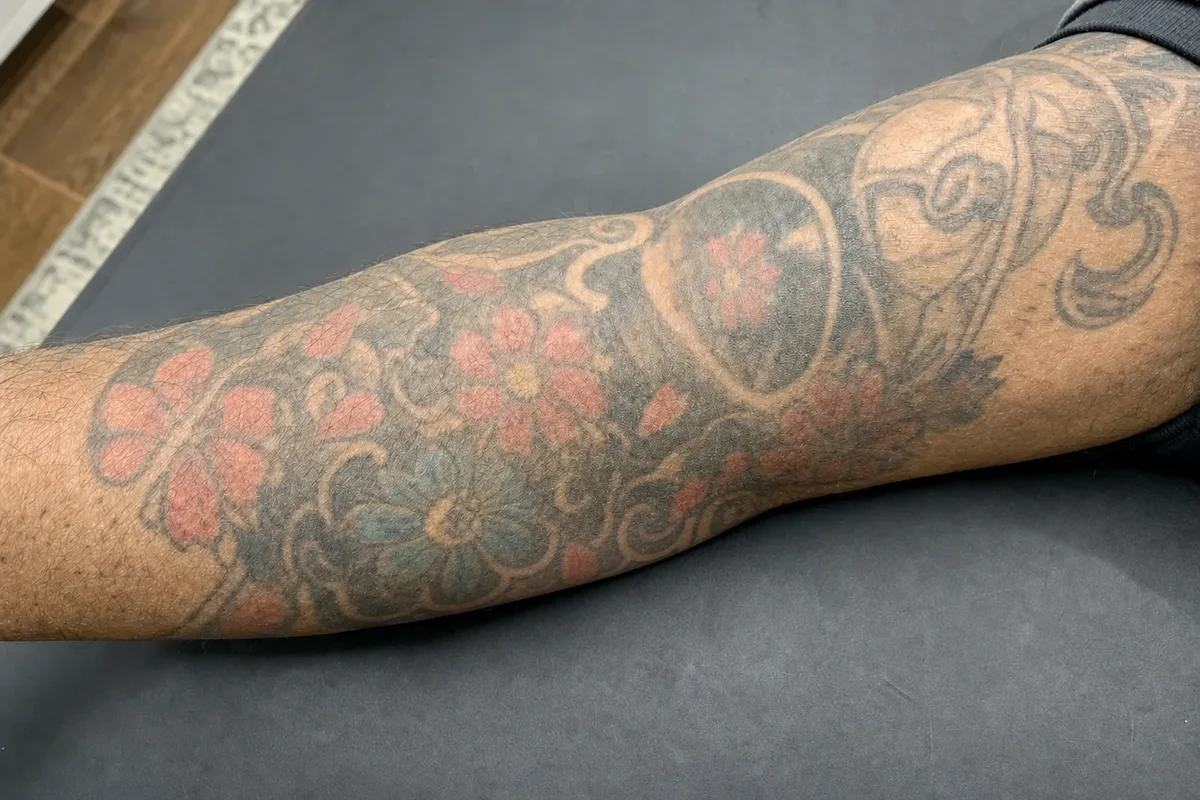
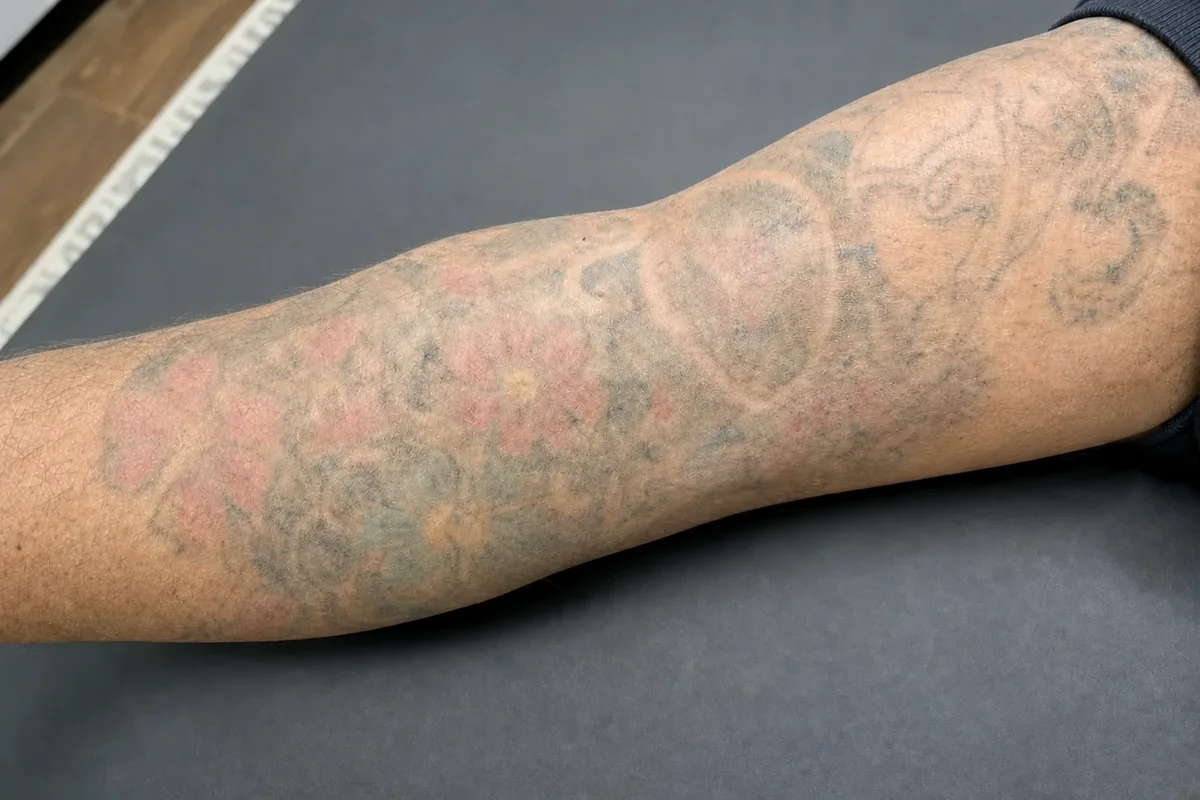
Real client results. Identifying details removed to protect privacy. Individual results vary; some inks fade rather than fully clear.
On cost: at many Melbourne clinics, more sessions means the bill multiplies per visit. Ink Off prices per session, from $80 (extra small, coin-sized) up to $300 (extra large, up to A4), no contract, no credit check, no lock-in. A stubborn colour piece means more sessions in the course, not a higher rate for your size band. As an example, not a quote: a small full-colour piece at $150 a session typically runs somewhere around $1,500–$2,100 over a 10–14-session course. Run your own numbers in the calculator.
Every plan is backed by Ink Off's 100% money-back guarantee, conditions apply, which matters more, not less, when your tattoo contains difficult colours.
Frequently Asked Questions
Many can, but it depends on which pigments are in the ink. Black, dark blue and red generally clear well with the right wavelengths. Green sits at the stubborn end, and yellow and white are the hardest of all. With some laser systems they may never clear completely. An honest consultation should tell you which category your tattoo falls into before you commit to anything.
Yellow, white and pale pastel inks are the most difficult because they reflect most laser wavelengths instead of absorbing them. Green is also demanding. It responds best to specific wavelengths such as 755nm that not every clinic's laser can produce. White ink carries an extra risk: it can oxidise and turn darker under the laser, which is why practitioners often test a small patch first.
There is no honest fixed number. Most tattoos need somewhere between 5 and 17 sessions, and colour pieces usually sit higher in that range than plain black work because each pigment responds at its own pace. Every tattoo responds differently. A free assessment can give you a provisional range based on your specific ink.
Yes. Ink Off runs a Cynosure PicoSure picosecond laser on premises in Kensington. Its core 755nm wavelength is well suited to black, dark blue and green ink. If your tattoo contains colours that are unlikely to respond well, you will be told that plainly at your free 20-minute video assessment rather than sold a treatment plan that cannot deliver.
Not by colour, no. Ink Off prices per session, from $80 to $300 depending on size, and colour on its own doesn't change the rate for a given size band. What colour can change is duration. A stubborn colour piece may need more sessions, which means a longer course, not a higher per-session price.
Sources & About This Guide
- Kirby W, Desai A, Desai T, Kartono F, Patel G. The Kirby-Desai Scale: A Proposed Scale to Assess Tattoo-Removal Treatments. J Clin Aesthet Dermatol. 2009;2(3):32–37.
- Cynosure PicoSure product and regulatory documentation (ARTG inclusion; FDA clearance).
- Further reading: Colour vs black tattoo removal, a neutral explainer on Tattoo Removal Guide (directory operated by Ink Off's founder).
This guide is general information, not medical advice. Ask your practitioner (or your GP) about your specific situation. Laser and pricing details describe Ink Off's own equipment and offer as at July 2026; session estimates are provisional ranges, never promises.
Related Guides
Not Sure How Your Colours Will Respond?
Take the free two-minute Check My Tattoo for a provisional session range, or book a free 20-minute video assessment, no obligation, and you'll get a straight answer about your specific ink plus a written plan.
100% Money-Back Guarantee (conditions) • PicoSure Laser • From $80 a Session