Tattoo Removal on Dark Skin: An Honest Guide
Darker skin and laser removal can absolutely work together, but only with the right assessment, conservative settings and a practitioner who respects melanin. Here's what careful treatment actually looks like, without the sales gloss.
Key Takeaways
- Darker skin can be treated, but melanin absorbs laser energy too, so wavelength choice and energy settings matter far more than on lighter skin.
- Your Fitzpatrick skin type must be assessed in person before anyone fires a laser. A photo is not an assessment.
- Expect a test patch, lower starting energy and possibly longer gaps between sessions. That's careful practice, not slow progress.
- Session counts are ranges, never fixed numbers. Most tattoos need somewhere between 5 and 17 sessions, and conservative settings can push darker skin toward the upper end.
- The main risks are pigment changes (lighter or darker patches). They're substantially reducible with the right approach and strict sun protection.
Why Melanin Changes the Equation
Laser tattoo removal works by firing very short pulses of light at your skin. Tattoo ink absorbs that energy and breaks apart into pieces tiny enough for your body's immune cells to carry away over the following weeks. Done well, the laser talks to the ink and largely ignores everything around it.
The complication with darker skin is that melanin, the pigment responsible for skin tone, also absorbs light. The more melanin in the skin, the more the laser has two competing targets instead of one. If the wavelength or energy level is wrong, some of that energy lands in the skin itself rather than the ink beneath it.
That is not a reason to write off removal. It's a reason to insist on a practitioner who plans around your skin rather than pretending it's the same as everyone else's.
The Fitzpatrick Scale, Plainly
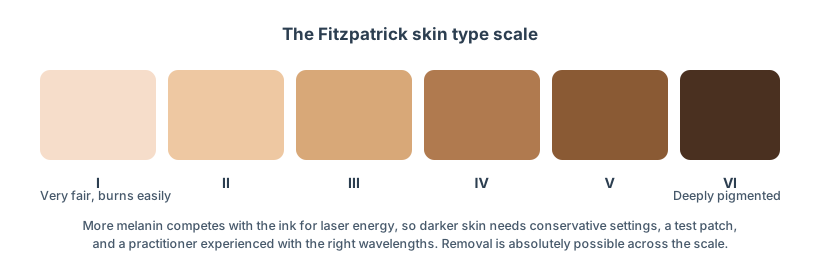
Practitioners classify skin using the Fitzpatrick scale, six types based on how skin responds to sun. It's the starting point for every safe treatment decision.
| Fitzpatrick type | Typical description | What it means for removal |
|---|---|---|
| I–II | Very fair to fair; burns easily | Standard settings; melanin rarely interferes |
| III | Medium; sometimes burns, tans gradually | Settings may need mild adjustment |
| IV | Olive to moderate brown; rarely burns | Careful wavelength choice; lower starting energy |
| V | Dark brown; very rarely burns | Conservative energy, test patch first, closer monitoring |
| VI | Deeply pigmented; never burns | Most conservative approach; gradual plan over more sessions |
If you sit in types IV to VI, two things follow. First, your assessment has to happen face to face. Skin type genuinely cannot be judged reliably from a phone photo, and any clinic willing to quote you settings from one is telling you how much care to expect later. Second, you want a practitioner who can explain, unprompted, how their settings change for your skin type. If that explanation isn't forthcoming, keep looking.
What Can Go Wrong, and How It's Prevented
The honest version of the risk conversation has two words in it: pigment change.
- Hypopigmentation: the laser affects melanin in the treated area and leaves patches lighter than the surrounding skin. Usually temporary, but it can take months to even out.
- Hyperpigmentation: the skin reacts to treatment by producing extra melanin, leaving darker patches around the site.
Blistering and, rarely, scarring can occur on any skin type when energy is set too aggressively. Darker skin simply narrows the margin for error.
The good news: these outcomes are largely preventable, and prevention isn't mysterious. It's a checklist:
- Wavelengths chosen for your skin type, not just your ink colour. Longer wavelengths pass through melanin more readily than shorter ones, which is why they're generally preferred on darker skin, while some shorter wavelengths used for reds and oranges are handled far more cautiously, or avoided, on types IV–VI.
- Lower starting energy, increased only as your skin proves how it responds.
- Cooling the skin ahead of each pass and again straight afterwards.
- A test patch before any full session.
- Strict sun protection between sessions. UV on freshly treated skin is the biggest pigmentation risk you control yourself.
A Note on Laser Types
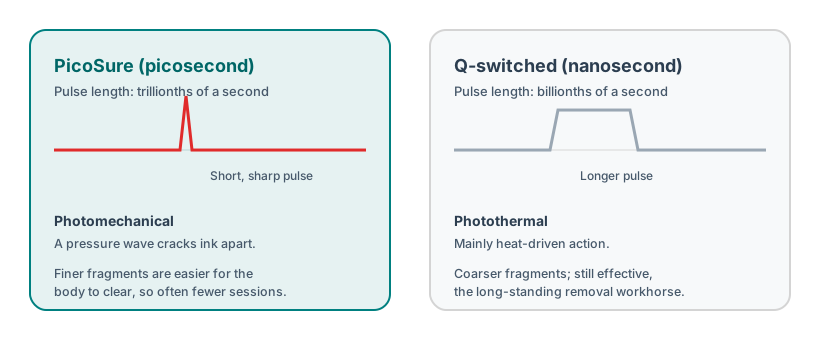
You'll read claims online that one laser category is “the answer” for dark skin. The fuller picture: both nanosecond (Q-switched) and picosecond machines have treated darker skin safely for years when driven at the right wavelength and energy. Picosecond lasers deliver their energy in far shorter pulses, breaking ink apart photomechanically, with a pressure wave rather than sustained heat, and they often need fewer sessions than older Q-switched machines. But pulse speed never substitutes for operator judgement.
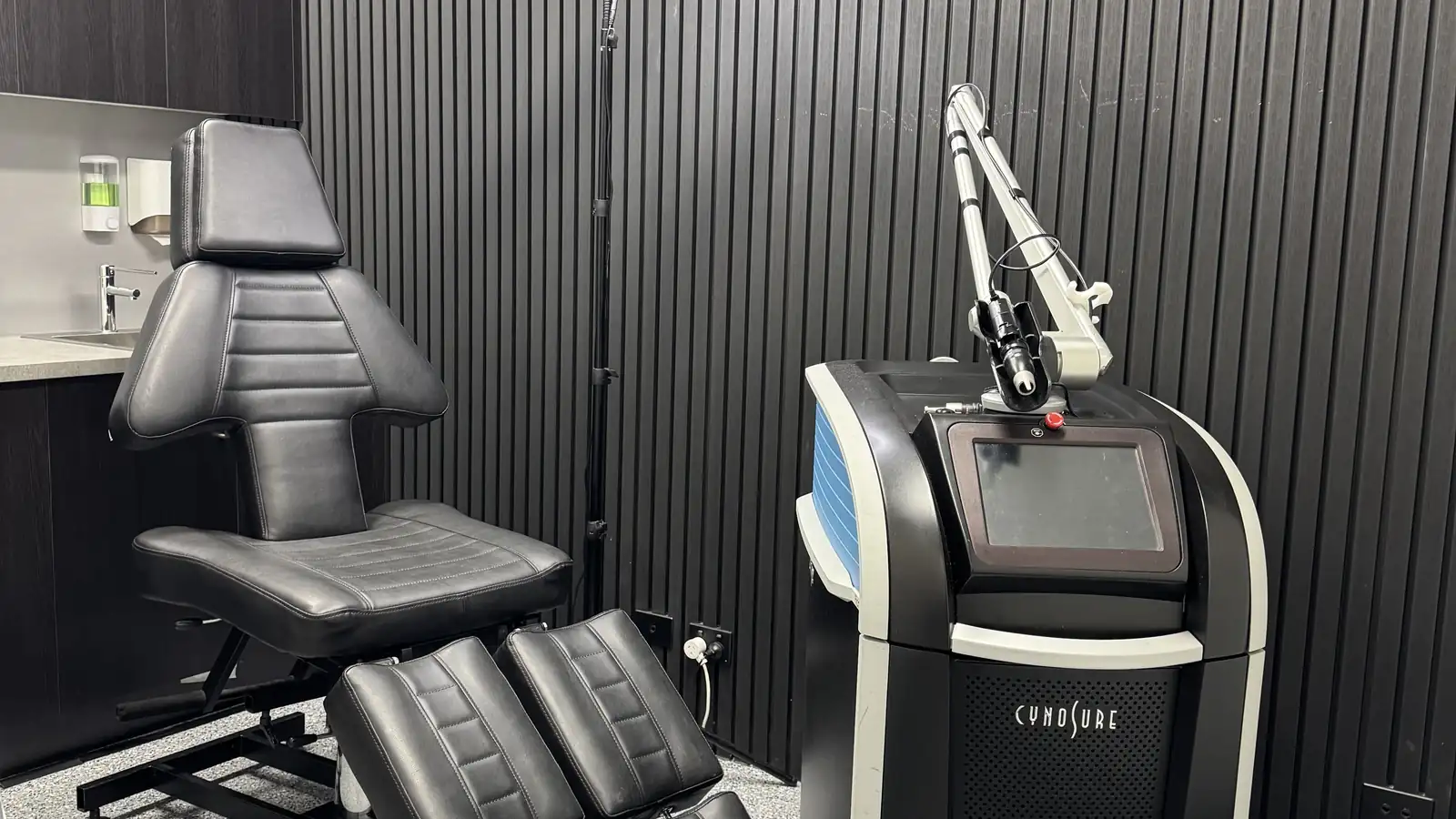
How Ink Off approaches it: we treat on a Cynosure PicoSure picosecond laser (ARTG-included and FDA-cleared), details on our technology page. Whether it's the right tool for your skin type and ink combination is precisely what the consultation and test patch exist to answer. We assess your Fitzpatrick type in person, we start conservatively, and if we don't believe we can treat you safely, we'll tell you that instead of booking you in.
What a Careful Treatment Plan Looks Like
Before anything else
- A free video assessment covering your skin type, tattoo, health history and sun habits. At Ink Off this is free: 20 minutes, no obligation, with a written plan.
- A test patch on a small section of the tattoo, reviewed after several weeks, before full sessions begin.
- A written plan stating the approach, the precautions for your skin type, and a session range, not a fixed count.
During each session
Sessions themselves are short, typically 5–15 minutes depending on tattoo size. On darker skin your practitioner should be starting at lower energy, cooling the skin actively, and watching how the treated area responds pass by pass rather than working to a preset recipe. Our preparation guide covers what to do in the fortnight beforehand. For darker skin, arriving without a fresh tan matters more than most people expect.
Between sessions
Sessions are typically spaced 6–8 weeks apart so your immune system can clear the shattered ink. On darker skin, your practitioner may stretch that interval further, giving any minor pigment shift time to settle before the next round. Longer gaps are a feature of careful treatment, not a delay to be negotiated down.
How many sessions overall
Most tattoos need somewhere between 5 and 17 sessions, with roughly 4 as a practical minimum, and every tattoo responds differently. Because conservative energy shifts less ink per visit, darker skin tends to land toward the upper end of its range. The Kirby-Desai scale, a published clinical assessment method, counts skin type among its core factors for exactly this reason. Treat any estimate, including ours, as a provisional range rather than a promise; our free 2-minute candidacy check will give you one in about two minutes, and an in-person consult refines it.
Aftercare: Where Darker Skin Needs Extra Discipline
Standard aftercare applies to everyone. Keep the area clean, moisturised and protected while it heals. For Fitzpatrick IV–VI, three points carry extra weight:
- Sun protection is non-negotiable. UV on treated skin drives pigmentation problems. SPF 50+ on the area every day of your course, overcast Melbourne days included, and cover it where practical.
- No tanning, sun or solarium, on or near the treated area for the duration of your plan.
- Report pigment changes early. If the area looks lighter or darker than expected between sessions, tell your clinic before the next appointment so settings can be adjusted. That feedback loop is how careful plans stay careful.
Questions to Ask Any Clinic Before They Treat You
Take these five to every consultation you sit, ours included:
- “How do your laser settings change for my skin type, and why?”
- “How much experience do you have treating Fitzpatrick types IV to VI?”
- “Will you do a test patch before full treatment?”
- “What's your plan if pigment changes appear between sessions?”
- “Would you decline to treat me if you thought it wasn't safe?”
The last one matters most. A practitioner who can say “yes, and here's when I would” is putting your skin ahead of their booking sheet. Anyone who breezes past these questions, or who doesn't appear to know the Fitzpatrick scale at all, has answered them anyway.
Frequently Asked Questions
In many cases, yes. Darker skin needs a more careful approach, an in-person Fitzpatrick skin type assessment, conservative laser settings, a test patch before full treatment, and close monitoring between sessions. The trade-off is usually a more gradual treatment plan, not an impossible one.
Often, yes. Practitioners deliberately use lower energy on darker skin to protect the surrounding pigment, so each session shifts less ink. Most tattoos need somewhere between 5 and 17 sessions, and darker skin tends to sit toward the upper end of its range. Every tattoo responds differently, so treat any figure as a provisional range, not a promise.
Pigment change is the biggest risk: hypopigmentation (lighter patches where melanin has been affected) and hyperpigmentation (darker patches where the skin over-produces melanin in response to treatment). Careful wavelength selection, conservative energy settings, skin cooling and strict sun protection substantially reduce both risks, but no practitioner can reduce them to zero.
A test patch means treating a small area of the tattoo first, then waiting several weeks to see how your skin and ink respond before committing to full sessions. For Fitzpatrick types IV to VI it is a sensible standard of care, and a clinic that offers one without being asked is showing you how it works.
Pigment changes after treatment are usually temporary and settle over weeks to months, but an honest practitioner will never promise your skin will look exactly as it did before. Minimising that risk is the whole point of conservative settings, test patches and diligent sun protection throughout your course.
Sources & About This Guide
- Fitzpatrick TB. The validity and practicality of sun-reactive skin types I through VI. Arch Dermatol. 1988.
- Kirby W, Desai A, Desai T, Kartono F, Patel G. The Kirby-Desai scale: a proposed scale to assess tattoo-removal treatments. J Clin Aesthet Dermatol. 2009.
- Ink Off technology, preparation and aftercare pages (linked above) for all Ink Off-specific details.
- Further reading: Tattoo removal on dark skin, a neutral explainer on Tattoo Removal Guide (directory operated by Ink Off's founder).
This guide is general information, not medical advice. Ask your practitioner (or your GP) about your specific situation, especially decisions about treating Fitzpatrick types IV–VI, medications that affect skin healing, or a history of keloid scarring or pigmentation disorders.
Related Guides
Start With an Honest Assessment
Your skin type is a variable to plan around, not a barrier. Get a provisional range online in two minutes, or book a free 20-minute video assessment, no obligation, and we'll tell you straight if we're not the right fit.
100% Money-Back Guarantee (conditions) • PicoSure Laser • From $80 a Session