How to Choose a Tattoo Removal Clinic in Melbourne
Melbourne has more tattoo removal clinics than almost any city in Australia. Here's a straight checklist for comparing them, the laser, the person running it, the real cost of a full course, the guarantee fine print, and the reviews.
Key Takeaways
- Ask exactly which laser a clinic runs and whether its wavelengths suit your ink colours. Picosecond and Q-switched machines both work, with different strengths.
- Compare the likely total cost of a full course, not the headline per-session price. Most tattoos need somewhere between 5 and 17 sessions.
- A guarantee is only worth what's in writing. Ask for the conditions before you pay a cent.
- Read reviews for volume, recency and detail. A bare star rating tells you very little on its own.
- Shortlist two or three clinics and sit a consultation at each. A good consult costs you nothing and tells you more than any website.
Why This Decision Deserves an Hour of Homework
Picking a removal clinic badly costs you in two ways. The obvious one is money: a course that drags on because the machine or the operator isn't right for your tattoo can run to thousands of dollars more than it should. The less obvious one is your skin. Burns, blistering and permanent pigment change are real outcomes when a laser is driven poorly.
Melbourne gives you plenty of choice. Tattoo Removal Guide, a national clinic directory, lists roughly 90 specialist tattoo removal clinics in Melbourne alone, and its data shows fewer than half of Australian clinics publish their pricing anywhere public. Choice is good. But it means the burden of comparison sits with you.
The checklist below covers the five things that actually separate clinics. Work through it before you book anything.
1. The Laser: Ask What's Actually in the Room
Tattoo removal lasers fall into two broad families:
- Q-switched lasers work in nanosecond pulses. This is the technology that has carried the industry for decades, and it remains effective, particularly on black ink.
- Picosecond lasers fire pulses roughly a thousand times shorter. The energy arrives so fast that ink shatters photomechanically (a pressure wave rather than heat) and they often need fewer sessions than older Q-switched machines.
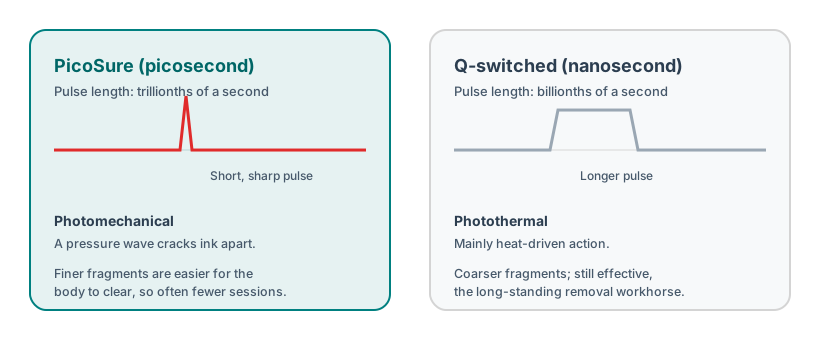
Neither family is automatically the right answer for you. What matters is whether the machine's wavelengths match the colours in your tattoo, whether the equipment is well maintained, and whether the operator knows how to drive it. A tired, decade-old laser of either type underperforms.
So ask three plain questions: What laser do you use? Which wavelengths does it produce? Is it effective on my specific colours? A confident clinic answers in ten seconds. An evasive one has just told you something important.
Where Ink Off sits: we run a Cynosure PicoSure picosecond laser on premises in Kensington, ARTG-included and FDA-cleared. You can read how it works on our technology page, and you're welcome to ask us the same three questions at a consult.
2. The Person Holding the Handpiece
Here's something many Melburnians don't realise: Victoria has no dedicated licensing scheme for laser tattoo removal operators. Unlike Queensland, Western Australia and Tasmania, where operating a class 4 laser requires a licence, in Victoria, anyone can legally buy a laser and start treating skin. That makes your own checks matter more here, not less.
What to look into:
- Removal-specific experience. Tattoo removal is not laser hair removal with different settings. Ask how many tattoos the practitioner has treated, and whether they've handled ink colours and skin types like yours.
- Stated qualifications. If a clinic advertises a registered health practitioner, you can verify the registration yourself on the public AHPRA register. If they don't, ask what laser safety and removal training the operator holds.
- Specialisation. A studio that removes tattoos every working day sees more ink types, skin types and complications than a beauty salon offering removal between facials. Ask what share of the clinic's work is tattoo removal.
None of these questions is rude. A practitioner who bristles at them is answering a different question, about how they'll handle you when something needs discussing mid-course.
3. Pricing: The Per-Session Number Hides the Real Cost
Removal is a multi-visit commitment. Most tattoos need somewhere between 5 and 17 sessions, typically spaced 6–8 weeks apart, and every tattoo responds differently. So a clinic quoting “$99 a session” hasn't told you the price. They've told you one instalment of an unknown total.
When you compare clinics, do the multiplication:
- Ask for an honest session range for your tattoo. Ranges are a sign of honesty; fixed numbers before an in-person assessment are a sign of salesmanship.
- Multiply the per-session price by the top of that range. That's the figure to compare, clinic to clinic.
- Ask what's extra: consultation fees, patch tests, numbing, aftercare products.
- Be wary of large prepaid packages. If you're unhappy three sessions in, you're locked in for seven more.
Pricing models vary too. At Ink Off, you pay per session, from $80 for an extra-small tattoo up to $300 for an extra-large piece (up to A4), no contract, no credit check, no lock-in. Pieces larger than A4 are treated in sections, quoted at consult, so you're never billed for skin you don't need treated. Melbourne clinics' median advertised price sits around $70 a session, with big-chain pricing running from $100 to $743 (TRG directory data, August 2026). Run your own numbers in our pricing calculator and check them against any quote you're given.
4. Guarantees: Get the Terms in Writing
Guarantees in this industry span the full spectrum, from clinics that promise nothing, to clinics that promise everything and honour little. Both extremes should make you pause. A verbal “don't worry, it'll all come out” is not a guarantee; it's a sales line, and complete removal can never be promised for every tattoo.
A guarantee you can actually rely on has three properties:
- It's written down and published, not delivered across the counter.
- It defines the outcome: what counts as removal, and how it's assessed.
- It states your side of the deal: attendance, spacing between sessions, aftercare compliance.
Ink Off offers a 100% money-back guarantee, and we hold ourselves to the same standard we're recommending: the conditions apply and are published in full on our guarantee conditions page for you to read before you spend anything. Whatever clinic you choose, ask for the equivalent document. If it doesn't exist, the guarantee doesn't either.
5. Reviews: Read Past the Star Rating
Removal results take months to show, which makes reviews unusually useful here. They're written by people who've lived through the timeline you're about to start. But read them properly:
- Recency: staff and machines change; reviews from this year beat reviews from five years ago.
- Specificity: “my colour piece faded noticeably by session four” is worth ten “lovely staff, five stars” entries.
- Patterns: the same practitioner praised repeatedly, or the same complaint recurring, tells you what's structural rather than one-off.
- Volume in context: chains accumulate hundreds of reviews across locations; an independent studio will have fewer. Judge the detail, not just the count.
For transparency: Ink Off holds a 5.0-star Google rating (21 reviews). You can read every one, unedited, on our Google profile or quoted verbatim on our reviews page. Apply the same scrutiny to us that you'd apply to anyone else.
6. The Consultation Is the Real Test
Everything above narrows your shortlist. The consultation makes the decision. A proper one is a clinical assessment, not a pitch, and it should include:
- An in-person examination of your tattoo, not an estimate from a phone photo
- Questions about your health, medications, sun exposure and skin type
- A session range grounded in real factors: ink colour and density, tattoo age, location on your body, your skin type. (The Kirby-Desai scale, a published clinical assessment method, formalises exactly these factors.)
- A walk-through of aftercare and what healing looks like between sessions
- Zero pressure to sign anything on the spot
Book consultations at two or three clinics and compare what you hear. Ink Off's consultation is a free 20-minute video assessment with a written plan, no obligation, and if you want a head start before you visit anyone, our free 2-minute candidacy check gives you a provisional session range for your tattoo in about two minutes.
Walk away if you see these
- A promise of complete removal, or a fixed session count quoted before anyone has examined your tattoo
- Evasiveness about which laser they use or who operates it
- A “guarantee” with no written conditions you can take home
- Pressure to prepay a large package at the first visit
- No aftercare instructions. If they don't care what happens after the laser stops, keep walking
Frequently Asked Questions
Most tattoos need somewhere between 5 and 17 sessions, typically spaced 6 to 8 weeks apart, and every tattoo responds differently. Be cautious of any clinic that quotes you a fixed number of sessions before examining your tattoo in person.
Not on price alone. Compare the likely total cost of a full course, the laser being used, the practitioner's removal experience and whether any guarantee comes with written conditions. A low per-session price stretched across many extra sessions can end up dearer than a clinic that fades your tattoo efficiently.
Both remove tattoos. Picosecond lasers deliver much shorter pulses that break ink apart with a pressure wave rather than heat, and often need fewer sessions than older Q-switched machines, but a well-operated Q-switched laser still does solid work. The person operating the machine matters as much as the machine itself.
An in-person look at your tattoo, questions about your health, medications and skin type, an honest session range rather than a fixed number, a clear breakdown of what a full course is likely to cost, and an explanation of aftercare. It should not include pressure to prepay for a large package on the spot.
Ask which laser and wavelengths the clinic uses, who operates it and how much tattoo removal experience they have, what a full course is likely to cost in total, whether any guarantee comes with published written conditions, and how they handle blistering or pigment changes between sessions.
Sources & About This Guide
- Tattoo Removal Guide, national directory dataset of Australian specialist tattoo removal clinics (May 2026), linked above.
- Further reading: How to choose a tattoo removal clinic, a neutral explainer on Tattoo Removal Guide (directory operated by Ink Off's founder).
- Kirby W, Desai A, Desai T, Kartono F, Patel G. The Kirby-Desai scale: a proposed scale to assess tattoo-removal treatments. J Clin Aesthet Dermatol. 2009.
- Australian Health Practitioner Regulation Agency (AHPRA), public register of practitioners.
- Ink Off pricing, guarantee conditions and technology pages (linked above) for all Ink Off-specific figures.
Tattoo Removal Guide is an independent clinic directory operated by Ink Off's founder. This guide is general information, not medical advice. Ask your practitioner (or your GP) about your specific situation.
Related Guides
Put Ink Off on Your Shortlist
Bring this checklist with you. Our consultation is a free 20-minute video assessment (no obligation) and we'll answer every question on it in plain English.
100% Money-Back Guarantee (conditions) • PicoSure Laser • From $80 a Session